



A feed program can turn into a shelf full of bottles. A grower starts with a base nutrient, adds a bloom booster, a Cal-Mag, a root product, and the shelf fills up. Even the base can be four bottles: many two-part lines have an A and B for veg and a different A and B for flower, and the grower changes over partway through the crop. Every extra bottle is one more thing to buy, measure and get wrong.
GreenPlanet built Dual Fuel to cut that back to two. Part 1 and Part 2 go in at the same amount as each other at every feed, from the first week of veg to the last week of flower, and between them they make a complete base feed. Only the dose changes as the plants grow.
We filmed a tutorial on Dual Fuel with Justin Cooper, co-founder of GreenPlanet Nutrients, and Sara Boon of GreenPlanet. Justin explained why the product is built the way it is, then mixed a 10-gallon reservoir on camera, from the first measure to the final pH reading.
Why GreenPlanet made Dual Fuel
When Sara asked why GreenPlanet made Dual Fuel, Justin said the industry was using so many different products. GreenPlanet wanted to simplify feed programs and limit how many products a grower has to buy to get the result they need.
“Typically most two parts are considered an A&B veg and an A&B flower. This is a true two-part.”
Justin Cooper, Co-Founder, GreenPlanet Nutrients
Dual Fuel was first built for commercial gardens. In British Columbia, where GreenPlanet started, a lot of gardens are commercial in size, and GreenPlanet wanted a product that worked at large scale. Justin says the same two bottles work just as well for a home grower with four plants.
Why one ratio matters in a commercial room
Large rooms are often fed with an injector, which draws concentrate from stock containers into the irrigation water on its way to the plants. GreenPlanet recommends Dual Fuel for exactly that setup because the two parts run 1:1 for the entire crop.
With Dual Fuel, the injector draws the same amount from Part 1 and Part 2. When the plants need a stronger or weaker feed, both go up or down together. There is no second set of concentrates to swap in when the room flips to flower, and no chance of a tank left on the veg formula. A home grower gets the same benefit at the reservoir, measuring the same amount from the same two bottles for the whole crop.
Two bottles, one complete diet
Justin says what is in each bottle on its own matters less than what you get when they meet in the reservoir. Between the two, the plant gets the primary elements, nitrogen, phosphorus and potassium; the secondary elements, including calcium; and all the micronutrients. He calls it a very complete diet.
GreenPlanet’s label shows how the work is split. The three numbers on a nutrient label are its NPK, the percentage of nitrogen, phosphorus and potassium.
- Dual Fuel Part 1 is 5-0-1. It carries the nitrogen and the calcium, plus the micronutrients, including chelated iron, manganese, zinc and copper. Chelated means bound in a form that stays dissolved and available to the roots.
- Dual Fuel Part 2 is 0-3-6. As Justin puts it, no nitrogen, a good amount of phosphorus and a very high amount of potassium. GreenPlanet’s label adds magnesium and sulfur.
Why it can’t come in one bottle
Sara asked the question most growers have. If the plant needs both bottles every time, why not put everything in one?
“So it’s virtually impossible to get a complete one-part synthetic food because certain elements don’t play well in the bottle with each other, specifically calcium.”
Justin Cooper, Co-Founder, GreenPlanet Nutrients
Justin says the one-part fertilizers on the market leave calcium out, and calcium is an important element for plant development. To get a complete food, it has to come in two bottles.
The chemistry behind his answer is the same reason other two-part nutrients come in two bottles, and GreenPlanet’s ingredient list shows it. Part 1 is made from calcium nitrate and potassium nitrate. Part 2 is made from potassium sulfate, monopotassium phosphate and magnesium sulfate. At concentrate strength, calcium reacts with sulfate and phosphate and forms solids that drop out of the liquid, and the nutrients in those solids are no longer available to the plant. Diluted in a full reservoir, they stay dissolved.
The reaction is the reason for the one rule on the Dual Fuel label.
“You never mix these two in concentrate together before you add to the reservoir.”
Justin Cooper, Co-Founder, GreenPlanet Nutrients
Justin says mixing them in concentrate leads to “monstrous lockout,” where the nutrients are in the reservoir but the plant can’t take them up.
What GreenPlanet says it left out
Justin says GreenPlanet built Dual Fuel without carbonates or food coloring, or anything else that didn’t need to be in there. Carbonates matter most on a drip system, because they can come out of solution as hard scale inside lines and emitters.
According to Justin, growers who run Dual Fuel typically see a clean reservoir and drip emitters that don’t clog, and many have told him it is the cleanest nutrient they’ve seen for the amount of salt residue left behind. He calls it 100% bioavailable and says it flushes well enough that you don’t need a flushing agent. If buildup is already clogging your lines, our article on why drip emitters keep clogging explains where it comes from.
How to mix a Dual Fuel reservoir
Justin starts with the water. His recommendation is to filter out chlorine at minimum, and he uses KDF-85 filter media. If you can afford it, he says reverse osmosis is the way to go, because it removes the contaminants and salts already in your water. Tap water’s dissolved minerals show up in your PPM reading before you add any nutrient. RO water starts near zero, so what you read after mixing is what you added.
His demo was a 10-gallon reservoir in veg.
- Know your volume. Every measurement comes from it. Justin’s reservoir held 10 gallons.
- Work out the dose and multiply. Justin used 9.5 ml of each part per gallon, which he called aggressive veg. Ten gallons makes 95 ml of Part 1 and 95 ml of Part 2.
- Dilute Part 1 in about a gallon of water, then add it to the reservoir. He measures with a syringe.
- Dilute Part 2 in a separate gallon of water, then add it. Same dose as Part 1. Before Part 2 goes in, Justin makes sure he knows Part 1 is already in.
- Check the strength. Justin’s EC reading came out at about 1,000 PPM, where he wanted it.
- Set the pH last.
Justin’s 9.5 ml is on the strong side. GreenPlanet’s label range is 2 to 10 ml of each part per US gallon, and its weekly feed chart tops out at 8 ml. Justin says all of GreenPlanet’s charts are a guideline, a baseline for an average plant. Some plants are heavier feeders, and if you know yours likes a higher PPM, you can dose to it. GreenPlanet’s paper charts are at hydroponics stores, and its nutrient calculator works out exact amounts when you enter your reservoir size.
Setting the pH without shocking the reservoir
Justin keeps the pH between 5.8 and 6.3, the range where all the elements are available for the plant to take up. GreenPlanet’s printed chart gives 5.8 to 6.5.
His reservoir only needed a tiny amount of pH up, and he still didn’t pour it straight in. He mixed about an ounce of pH up into about a litre of water and added that slowly until he hit his number. Diluting it first avoids a harsh adjustment.
Watch the water while you add it. Justin says clouding is a sign that nutrients are locking out, and diluting the pH up and adding it slowly is how he keeps the reservoir clear.
What to add on top of the base
Justin calls Dual Fuel the steak and potatoes.
“This is your base food. If you want vitamins, something to beef up size, something to add resin content.”
Justin Cooper, Co-Founder, GreenPlanet Nutrients
He named three GreenPlanet additives for flower. He says Massive Bloom Formulation is designed to increase flower size and density, Dense creates a harder flower and Rezin a more resinous one. GreenPlanet’s Dual Fuel feed chart also includes Vitathrive and Liquid Weight.
Justin says the sky is the limit with additives, but Dual Fuel is the base, and lots of growers run it on its own and get incredibly good results.
Store both bottles somewhere cool and dark. GreenPlanet made the bottles black because light can degrade nutrients.
Get GreenPlanet Dual Fuel
Growing Exposed does not sell nutrients, but GreenPlanet Nutrients does. Contact them directly, or use the links below to learn more.
Learn more and buy Dual Fuel Part 1 and Part 2 at GreenPlanet Nutrients. Work out your exact amounts with the GreenPlanet nutrient calculator.
Commercial grower? Find your GreenPlanet rep. Call GreenPlanet toll free at 1-866-913-4769 or email info@mygreenplanet.com and ask who your sales rep or distributor is. GreenPlanet has reps and distributors in Canada, the United States, Australia and Europe. Contact GreenPlanet Nutrients
Common questions
How much Dual Fuel per gallon, and what PPM should I aim for?
GreenPlanet’s feed chart uses the same amount of Part 1 and Part 2: 2, 4 and 8 ml per gallon through the three weeks of veg, 8 ml in the first week of flower and 6 ml for flower weeks two to seven. The chart’s target climbs from 150–250 PPM in the first week of veg to 850–950 PPM through most of flower. In metric, the label range is 0.5 to 2.5 ml per litre of each part.
Does it matter whether Part 1 or Part 2 goes in first?
GreenPlanet’s directions only say to add the two parts to the reservoir separately. Justin adds Part 1 first, then Part 2. What matters is that each part is diluted in water before it meets the other.
Do I need Cal-Mag with Dual Fuel?
GreenPlanet’s Dual Fuel feed chart does not include a separate Cal-Mag. According to GreenPlanet’s label, Part 1 carries 5% calcium and Part 2 carries 1.5% magnesium, so both are already in the base.
Can I use Dual Fuel in soil or coco?
Yes. GreenPlanet lists Dual Fuel for hydroponics, drain-to-waste and recirculating systems, and for soil and soilless media, which includes coco. The same feed chart applies.
How do I flush with Dual Fuel?
GreenPlanet’s chart ends with a flush week. Dual Fuel comes out, the EC drops to about 0.1, and Rezin and Liquid Weight stay in at their usual rates. Justin says you don’t need a separate flushing agent. Our article on whether you need to flush cannabis covers the last stretch before harvest.
Watch the full video
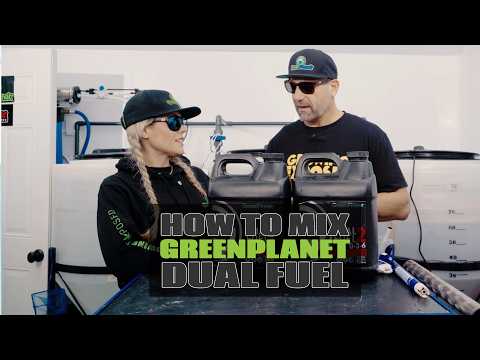
Sara Boon of GreenPlanet takes Justin Cooper, GreenPlanet’s co-founder, through Dual Fuel: why it is two bottles instead of one, how to mix a 10-gallon reservoir and how to set the pH without shocking it. About 10 minutes.
