

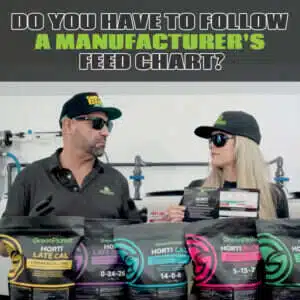



Every nutrient manufacturer gives you a feed chart. How closely should you actually follow it?
Justin Cooper, co-founder of GreenPlanet Nutrients, says it depends on what you’re growing. Some strains can handle more than the chart recommends. Others need less. He always leans toward feeding less, because an overfed plant is very hard to bring back.

Why the chart isn’t right for every strain
A feed chart has to work for everyone who buys the product, so its numbers are set for a wide range of plants. Cannabis genetics vary, and so does how much food they want. When Sara Boon of GreenPlanet asked Justin whether growers have to follow the chart exactly or use it as a guide, he said:
“So every single genetics, every single plant uses a different EC or TDS.”
Justin Cooper, Co-Founder, GreenPlanet Nutrients
EC and TDS are the meter readings growers use to measure feed strength. Some strains are heavy feeders and take a strong feed. Others are sensitive to it. Two strains in the same room can respond very differently to the same feeding program, so if you’re running more than one, it helps to know how each one likes to be fed.
Justin says that once you’re familiar with how a strain grows, you can tailor the chart to it, for example by adding a little more nitrogen in veg.
Why overfeeding causes more problems than underfeeding
Sara also asked Justin about the most common mistake growers make with salt nutrients. He said overfeeding.
“There’s a real belief that more is better. And I’m from the school of less is more.”
Justin Cooper, Co-Founder, GreenPlanet Nutrients
Feeding more than the plant can use raises the salt level in the root zone. When it climbs too high, the plant has a harder time taking up water and nutrients, which growers call lockout. Justin says a plant that gets there is hard to bring back:
“So when you push a plant too hard and you overfeed, it’s very difficult to bring it back and flush that plant, and it basically locks the plant out.”
Justin Cooper, Co-Founder, GreenPlanet Nutrients
He also points out that the white residue on drip emitters, tables and the tops of pots is food you paid for that the plant never used.
GreenPlanet sells more nutrients when growers feed more, and Justin still tells them to lean toward less.
Research backs up the idea that more food doesn’t automatically mean a better crop. Cannabis Business Times reported in 2021 on work by researchers at North Carolina State University, who compared two commercial feed programs with their own. In NC State’s trials, which were unpublished at the time, phosphorus above about 30 ppm didn’t appear to be worth the cost. The commercial programs they looked at called for as much as 196 ppm at bud set.
How to adjust your feeding program
Start at the chart’s rate or a little below it, then watch how your plants respond over the next few feeds. If they show they want more, raise the strength in small steps and change one thing at a time, so you know what made the difference.
Check your EC or PPM every time you mix. If you run to waste, check the runoff as well. A runoff reading that keeps climbing above what you’re feeding is a sign salt is building up in the medium.
When you find the strength that works for a strain, write down how much nutrient it took. Justin says the back and forth should only happen once, because next time you know exactly what to mix.
Using GreenPlanet’s Horti feed chart
The chart Justin is talking about in the video is for GreenPlanet’s Horti Commercial Line, dry salt nutrients that you mix two bags at a time depending on the stage of the crop. It lists how much of each product to use at each stage and the strength to aim for, and you can open it from the QR code on the back of every bag. Justin calls it “a general guide to get you up and running.” Our article on how to mix GreenPlanet’s Horti line walks through mixing a batch step by step.
Common questions
What’s the difference between EC, TDS and PPM?
EC, electrical conductivity, measures how much dissolved salt is in your feed. Most pens convert EC into TDS, shown as PPM, using either a 500 or a 700 scale. The same feed at an EC of 1.0 reads 500 PPM on one scale and 700 on the other, so check which scale your pen uses before you compare it with a feed chart.
Can a plant recover from nutrient lockout?
Often, if you catch it early. The goal is to bring the salt level in the root zone back down, and many growers do that with pH-adjusted water before going back to a lighter feed. Damaged leaves won’t turn green again, so judge recovery by the new growth. Our article on whether you need to flush cannabis covers flushing in more detail.
Should I start a new nutrient line at half strength?
Many growers start a new line or a new strain below the chart’s rate and work up as the plants show they want more. Some charts are already set on the light side, so look at where yours starts before you cut it. Justin’s own approach is to lean toward less.
Learn more about Horti
Growing Exposed does not sell nutrients, but GreenPlanet Nutrients does. Learn more about the Horti Commercial Line and its feed program at GreenPlanet Nutrients. Commercial growers can find their GreenPlanet rep by calling 1-866-913-4769 or emailing info@mygreenplanet.com.
Watch the full video
This clip comes from our tutorial on GreenPlanet’s Horti Commercial Line, where Sara Boon takes Justin Cooper through the five Horti products, three ways to mix them and growers’ most common questions. About 12 minutes.
