



If you feed through drip lines, you’ve probably dealt with clogged emitters. One plant suddenly isn’t getting fed, and you usually don’t notice until it starts looking different from everything around it.
There are several things that can clog an emitter, but when you feed through your lines, one of them is mineral buildup from your nutrient solution.
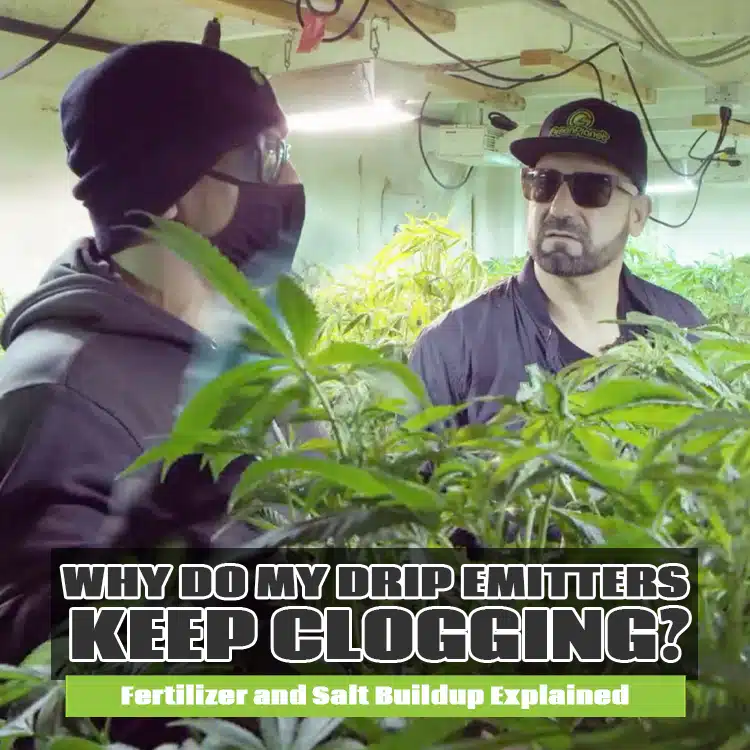
We saw an interesting example while filming a grower in British Columbia.
He had switched his base nutrient from General Hydroponics to GreenPlanet GP3. He didn’t switch because of clogged lines. He switched because the NPK numbers were the same and GP3 saved him money.
Then GreenPlanet co-founder Justin Cooper asked him something: was he getting as much salt buildup?
The grower stopped and thought about it.
“Yeah, I definitely don’t get it nearly as much as I used to, now that you mention it.”
— The grower, Growing Exposed Season 3, Episode 7
Justin says there’s a reason for that: GP3 is made without carbonates.

So what are carbonates, and what do they have to do with clogged drip emitters?
What are carbonates?
Carbonates are part of the mineral chemistry behind scale. If you’ve seen hard white buildup around your drip emitters, that’s the kind of problem we’re talking about. Some of that crust can be dried fertilizer salt. Some of it can be scale, a hard mineral deposit such as calcium carbonate.
Under the right conditions, calcium and carbonate in your nutrient solution combine and come out of solution as a solid. On the outside of an emitter, you can see that buildup and scrape it off. Inside, the opening is tiny, and enough of it restricts the flow until the emitter clogs.
The University of California says fertilizer injection into drip systems, which they call fertigation, “can cause clogging problems in the emitters.” Your nutrient solution goes through every emitter on every feed, so what is in it matters.
Salt buildup, scale and clogged emitters
Growers call most crusty white residue “salt buildup.” There are really three related things going on:
- Salt in the growing medium. Fertilizer dissolved in water is a soluble salt. As the plant uses water and the rest evaporates, the minerals stay behind in the medium and collect feed after feed.
- Scale in your irrigation. Minerals come out of the nutrient solution and form a hard deposit inside lines, fittings and emitters.
- A clogged emitter. The emitter stops delivering, and that plant stops getting fed.
Salt in the medium shows up on the plant: reduced growth, brown leaf tips, lower leaves dropping, small new growth and wilting, according to the University of California. Colorado State University says excess salts burn foliage, damage roots and make it harder for the plant to take up water.
Why this grower’s answer matters
The grower in this story runs a vertical garden in shipping containers. Every plant is fed from a pump through spaghetti lines, the thin tubes that run from the main line to each pot, so his emitters see every feed.
Less salt buildup isn’t why he switched. He switched because the numbers matched what he was already using and GP3 cost him less:
“So I used to use General Hydroponics, then GP3 came out from GreenPlanet. Everything was exactly the same, so it was an easy switch and it saved me money.”
— The grower, Growing Exposed Season 3, Episode 7
Justin brought up salt buildup after that. The grower hadn’t been looking for a difference. He answered from what he’d seen in his own garden.
We’ve run GP3 a lot ourselves, and we’ve seen the same thing. The NPK is the same. The chemistry is better, and that makes a huge difference. Justin’s explanation:
“There’s no carbonates in this product, so therefore not having carbonates ensures you’re getting a cleaner flush, less salt buildup.”
— Justin Cooper, Co-Founder, GreenPlanet Nutrients

What is GP3?
GP3 is GreenPlanet Nutrients’ three-part base nutrient:
- GP3 Grow: 2-1-6
- GP3 Micro: 5-0-1, with iron, boron and calcium
- GP3 Bloom: 0-5-4
If you’re used to the three-part Flora Series, this is an easy switch: Grow for Grow, Micro for Micro, Bloom for Bloom. The NPK numbers match part for part.
Mix each part into your reservoir separately. GreenPlanet says combining the parts undiluted can cause nutrient lockout, which is when nutrients bind together and the plant can’t use them.
GP3 is formulated without carbonates. GreenPlanet’s retailers in Australia describe GP3 Grow as “free of synthetic dyes and carbonates.”
What to do about buildup
If you’re already seeing buildup, start here:
- Flush the medium. The University of California’s guidance for container plants is to pour plain water through the pot, about twice the pot’s volume, and let it drain completely.
- Check your emitters and lines. Clean or replace any emitter that has slowed down or stopped.
- Look at what you’re feeding. Whatever goes into your reservoir goes through every emitter.
Then try what this grower did. He switched to GP3 for the price and the matching numbers, and when Justin asked, he realized he was getting a lot less salt buildup. Run it in your garden and see for yourself.
Growing Exposed does not sell nutrients, but GreenPlanet Nutrients does. Contact them directly, or use the links below to learn more.
Fighting mineral buildup in your irrigation system? Try GP3 for one run and see what your lines and emitters look like. Buy GP3 or learn more
Commercial grower? Find your GP3 rep. Call GreenPlanet toll free at 1-866-913-4769 or email info@mygreenplanet.com and ask who your sales rep or distributor is. GreenPlanet has reps and distributors in Canada, the United States, Australia and Europe. Contact GreenPlanet Nutrients
Common questions
Why do drip emitters clog?
When you feed through drip lines, one cause is mineral scale from the nutrient solution. The University of California says fertilizer injected through a drip system can cause emitter clogging.
What does salt buildup look like?
In the pot, a white or yellow crust on the surface of the medium or around the pot. On the plant, brown leaf tips, lower leaves dropping, small new growth and wilting.
How do you remove salt or mineral buildup?
In the growing medium, flush with plain water, about twice the pot’s volume, and let it drain completely. If the salt level is very high, repot the plant. In the irrigation system, check your emitters and clean or replace any that have slowed down or stopped.
Does GP3 contain carbonates?
No. GP3 is formulated without carbonates, according to Justin Cooper, co-founder of GreenPlanet Nutrients. GreenPlanet’s Australian retailers also describe GP3 Grow as free of carbonates.
Watch the full episode
The grower’s story comes from Growing Exposed Season 3, Episode 7, hosted by Amanda MacKay. Justin Cooper rides in a blacked-out van to a BC black market grow, where the plants grow sideways up the walls of shipping containers. The GP3 conversation starts at 29:51. The episode also includes David Robinson, author of The Grower’s Handbook, and a tour of the ONA odor neutralizer plant with founder Shane Lander.
The full episode, with its own write-up, is on the Season 3, Episode 7: Black Market page. It is also on YouTube, where it is age-restricted, so you need to sign in to watch it there.
