





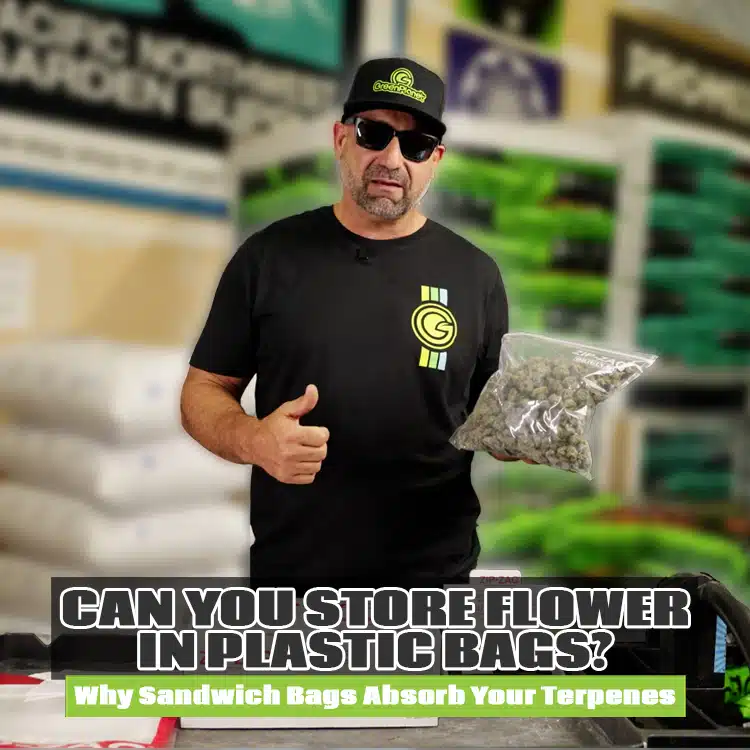
Sure you can, but you might not want to once you know what the bag is doing. Sandwich bags are made of polyethylene, and polyethylene absorbs terpenes. Leave your harvest in one and some of the smell you spent months growing ends up in the plastic.
You fed that crop for months, checked on it every day and picked the day to cut it. Then it goes into a bag. Whatever you put it in should preserve all of that, not pull from it.
A proper storage bag like a Zip-Zag is built for the job, from a multi-layer barrier film. A good storage bag does five things: it keeps the smell in, keeps air and water out, stands up to sharp stems, reseals without forcing it, and comes in a size that fits your harvest.

Why do sandwich bags absorb terpenes?
Because the terpenes move into the plastic itself. Nothing is leaking out through holes. Sandwich bags are made of low-density polyethylene, and polyethylene takes up aroma compounds from whatever it is holding. The packaging industry calls this flavor scalping.
Limonene is one of the main terpenes in cannabis, and packaging research has found that polyethylene absorbs it. Justin Cooper, co-founder of GreenPlanet Nutrients, puts it simply:
“Typical sandwich bags contain and are manufactured with polyethylene plastic, and polyethylene plastic absorbs those terpenes that you’ve spent months trying to create.”
— Justin Cooper, Co-Founder, GreenPlanet Nutrients
That research was done on food and drink packaging, not on cannabis in a sandwich bag. It is the same plastic and the same kind of compound, so there is good reason to expect the same thing, but nobody has measured how much smell a bag takes or how fast. Sealing a sandwich bag does not stop the loss, because the terpenes go into the bag wall itself.
What should you look for in a storage bag?
Any bag you store dried flower in should do these five things.
- Airtight and odor-proof. The seal and the film together keep the smell in the bag and the air out.
- Watertight. Moisture content is part of what you are trying to keep, and a bag that lets water in or out changes it.
- Puncture resistant. Dried flower has sharp sticks and stems. A thin bag gets holes in it, and a bag with a hole is not airtight.
- Reusable and easy to seal. You should not have to force the seal, and it should open and close as many times as you need.
- The right size. Half pound, one pound and kilo bags let you match the bag to the amount you are storing.
How do you open a Zip-Zag bag?
Hold the top of the bag with both hands and roll your thumbs into each other. The bag pops open.
“How you open the bag itself is you grab your thumbs, the bag open like this, and you roll your thumbs into each other, and it pops the bag open. This I didn’t know.”
— Justin Cooper, Co-Founder, GreenPlanet Nutrients
Justin Cooper says the trick is part of what makes the bags easy to reuse. They seal easily, and you do not have to force them closed.
Zip-Zag Brand Bags measured against the list
Zip-Zag Brand Bags meet all five, on the manufacturer’s specs and what Justin Cooper shows on camera. The bags use a multi-layer barrier film the company calls EnviroLock, with a precision-seal zipper. Zip-Zag says its odor-proofing is validated using BS EN 13725 methods, the European standard for measuring odor concentration, and that the bags withstand over 200 lbs of external pressure without bursting.
They come in half pound, one pound and two pound (1 kg) sizes, in clear and in black, plus a 1 oz bag and stand-up versions. The two pound bag is 43 by 43 cm. They are reusable and dishwasher-safe, and each has a flange above the zipper for heat sealing, for extra security or long-term storage. Zip-Zag has made them in North America since 2005.
The trade-off is thickness. Justin Cooper points out that a Zip-Zag is not the thickest bag, and that it still holds up to sharp stems:
“It’s not the thickest bag, but it also is extremely puncture resistant. And when we’re talking about flower, we’re talking about sharp sticks and stems that could puncture that bag quite easily. And this bag really stands up to it.”
— Justin Cooper, Co-Founder, GreenPlanet Nutrients
GreenPlanet Wholesale distributes Zip-Zag in Canada. Growing Exposed does not sell storage bags. If this is the bag you want:
- GreenPlanet Wholesale
- Contact GreenPlanet Wholesale, toll free 1-866-913-4769
Common questions
Do odor-proof bags block all smell?
Only when the seal is fully closed and the bag has no holes. Zip-Zag says its bags are tested using BS EN 13725 methods, a European standard for measuring odor concentration. A seal left partly open, or a stem through the bag, lets smell out whatever the bag is made of.
Can you reuse a storage bag?
Yes, if the bag is built for it. Zip-Zag bags can be opened, closed and reused many times, and the company says they are dishwasher-safe.
Should you use clear or black bags?
Both work, as long as the bag is kept somewhere dark. Clear lets you see the flower without opening the bag. Black hides the contents. Zip-Zag says its bags carry a UV barrier either way.
Can you store cannabis in the freezer?
Yes, and cold slows the breakdown of THC. A four-year study published in Forensic Science International stored samples at room temperature, in a fridge at 4 °C and in a freezer at -20 °C. At room temperature almost all of the THC had broken down after four years. In the freezer there was no meaningful loss.
Can you store cannabis in the fridge?
Yes. In the same four-year study, a fridge at 4 °C slowed THC loss considerably compared with room temperature, though not as much as a freezer. Both cold samples in that study were also kept in the dark.
Does light affect stored cannabis?
Yes. In the four-year study, samples kept in the light lost THC faster than samples kept in the dark at the same temperature. Light also changed how much CBN, another cannabinoid, formed as the THC broke down. Store bags somewhere dark, or use black bags.
What size bag do you need for a pound of flower?
A one pound bag, which Zip-Zag also labels 500 g. The half pound bag holds 250 g and the two pound bag holds 1 kg.
Can you heat-seal a storage bag?
You can on Zip-Zag bags. Each one has a flange above the zipper for heat sealing, for extra security or long-term storage.
Are Zip-Zag bags food safe?
Yes. Zip-Zag says all components comply with FDA, KOSHER and CFIA regulations.
Nothing on the outside of the bag tells you which one you are holding. Where the coconuts were grown, how thoroughly the fiber was washed, how finely it was ground and whether it was buffered before it shipped are set during processing. Some of it a grower can work around after the fact, and buffering is the obvious example. Most of it cannot be changed once the bag is open, which is why it is worth knowing what you are buying.
Coco is an inert medium, which means it holds no fertilizer of its own and keeps very little nutrient reserve between irrigations. Everything the plant gets comes from you. It also has a natural attraction to calcium and magnesium, so a bag that has not been properly buffered can bind some of what you feed and make it less available to the plant.
There are six things that separate a good bag of coco from a poor one: buffering, washing and starting EC, where the coconuts were sourced, the grind, third-party certification, and whether the product is consistent from batch to batch. Each one is covered below, along with what to ask before you buy.
What is coco coir?
Coco coir is a growing medium made from coconut husk. The husk is stripped off during food processing, so the material is a byproduct of a crop harvested every year.
The husk gives three fractions, and most bags are a blend. The ratio is what you feel when you handle it.
- Coir pith, also called coco peat. The fine powdery part. Holds most of the water.
- Coir fiber. Long coarse strands. Creates air space.
- Coir chips. Chunks of husk. Aeration and water retention together.
Almost all of it is processed in India and Sri Lanka. The husks are retted, separated, washed, dried, graded and compressed into bags or blocks.
How often do you feed coco?
Every irrigation should carry your nutrient solution. Coco is an inert medium, so it holds no fertilizer of its own and keeps very little reserve between waterings. That makes it closer to a hydroponic system than to a soil, and it means there is no plain-water day in a coco schedule.
“When growing in coco, it’s considered a hydroponic medium, which means it’s inert. There’s no fertilizer in this product. You have to feed consistently, over and over. It’s not a feed, water, feed, water.”
— Justin Cooper, Co-Founder, GreenPlanet Nutrients
Soil and peat mixes work differently. They carry a nutrient charge and hold a reserve the plant can draw on between
